

In the complex ecosystem of high-end manufacturing, dies and molds are the core elements that determine product precision, strength, and production efficiency. From powertrain housings to body structural parts, from hot-stamped safety components to precision sand cores, the birth of every critical part relies on the robust support of specialized tooling. The following text, organized around six key process tooling types, illustrates the foundations of modern casting and forming technologies.
Die Casting Die – The core tool for high-pressure, high-speed metal forming. It withstands extreme thermal shock and mechanical loads, requiring excellent wear resistance, thermal fatigue resistance, and precise venting. Whether for aluminum, magnesium, or zinc alloy parts, a high-quality die casting die enables efficient mass production of thin-walled, complex geometries with surface finish and dimensional consistency far superior to conventional processes.
Gravity Die Casting Mold – Relies on the gravity flow of molten metal to fill the cavity, making it suitable for castings requiring high density and minimal gas porosity. Typically using a permanent metal mold with a well-designed gating system, it is widely applied in components such as automotive wheels, valve bodies, and aircraft fittings. The advantages of a gravity die casting mold include dense microstructure, excellent mechanical properties, and greater flexibility for small-batch, multi-variety production compared to high-pressure die casting.
Hot Stamping Die – An indispensable solution for forming ultra-high-strength steel sheets. After heating the blank to the austenitizing temperature, it is rapidly transferred into a hot stamping die equipped with cooling channels, where forming and quenching occur simultaneously to produce a martensitic structure with tensile strengths exceeding 1500 MPa. Such dies must precisely balance temperature distribution and pressure to control spring-back and avoid cracking, making them critical equipment for producing automotive safety components such as A-pillars, B-pillars, and anti-intrusion beams.
Low-Pressure Die Casting Mold – An ideal choice when smooth cavity filling and capital efficiency are both priorities. By introducing dry compressed air into a sealed holding furnace, molten metal rises through a fill tube and fills the mold cavity in a laminar flow regime, greatly reducing oxidation and entrapment. This process is particularly suitable for parts requiring pressure tightness and heat treatment responsiveness, such as wheels, cylinder heads, and turbocharger housings. The design focus of a low-pressure die casting mold lies in riser system insulation, parting line sealing, and local pressurization mechanisms.
Patterns for Molding Line – These patterns create the external shape of castings on sand molding lines. They must withstand the impact of high-speed molding and sand flow erosion, and are therefore commonly made of aluminum alloys, cast iron, or resin, with draft angles, parting lines, and locating pins built in. A set of accurate patterns for a molding line significantly reduces rework on sand molds and improves casting dimensional consistency, serving as a prerequisite for efficient operation of modern high-pressure or flaskless molding lines.
Core Boxes – Used to manufacture sand cores that form internal cavities or complex voids in castings. Whether hot-box, cold-box, or shell-core type, core boxes must consider shooting direction, vent placement, and sealing at the parting line. High-precision core boxes produce sand cores with dense surfaces and good collapsibility, thereby creating clear oil galleries, water jackets, or intake/exhaust ports during casting. They are the critical enabler for complex castings such as engine blocks and hydraulic valve bodies.
In summary, from the rapid solidification of a die casting die, to the sound feeding of a gravity die casting mold, from the quench hardening of a hot stamping die, to the laminar filling of a low-pressure die casting mold, and finally supported by the efficient shaping of patterns for a molding line and the precise core-making of core boxes – these six categories of tooling together constitute a complete manufacturing chain for modern metal forming and casting. Each type of die, mold, pattern, or core box plays an irreplaceable role within its dedicated process area, providing reliable pathways from raw material to near-net-shape components for industries such as automotive, aerospace, energy, and general machinery.
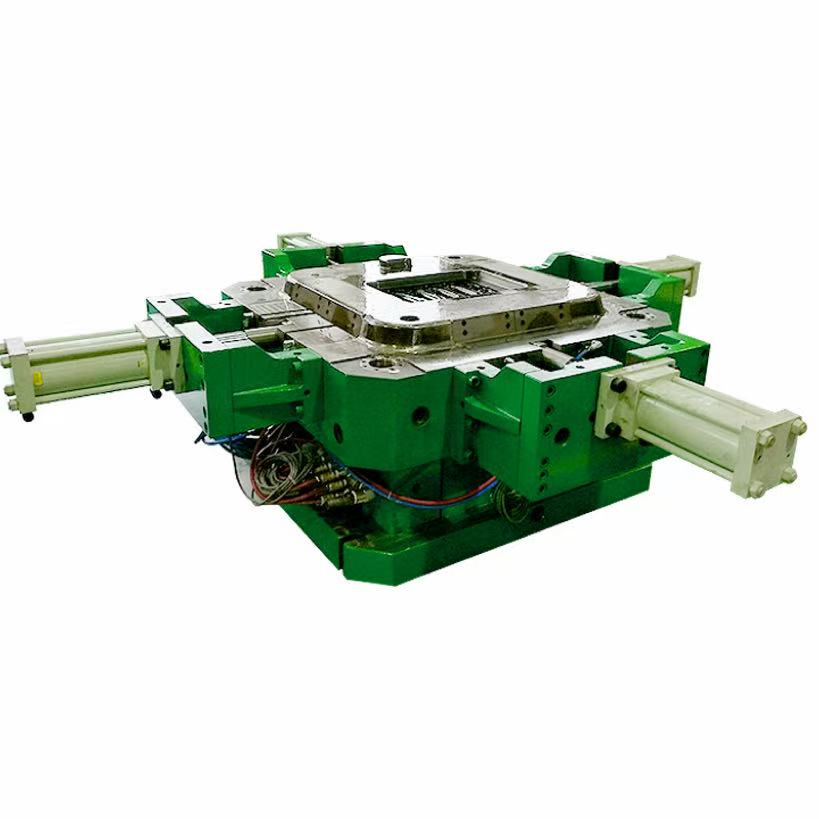
Die Casting Die – The core tool for high-pressure, high-speed metal forming. It withstands extreme thermal shock and mechanical loads, requiring excellent wear resistance, thermal fatigue resistance, and precise venting. Whether for aluminum, magnesium, or zinc alloy parts, a high-quality die casting die enables efficient mass production of thin-walled, complex geometries with surface finish and dimensional consistency far superior to conventional processes.
Gravity Die Casting Mold – Relies on the gravity flow of molten metal to fill the cavity, making it suitable for castings requiring high density and minimal gas porosity. Typically using a permanent metal mold with a well-designed gating system, it is widely applied in components such as automotive wheels, valve bodies, and aircraft fittings. The advantages of a gravity die casting mold include dense microstructure, excellent mechanical properties, and greater flexibility for small-batch, multi-variety production compared to high-pressure die casting.
Hot Stamping Die – An indispensable solution for forming ultra-high-strength steel sheets. After heating the blank to the austenitizing temperature, it is rapidly transferred into a hot stamping die equipped with cooling channels, where forming and quenching occur simultaneously to produce a martensitic structure with tensile strengths exceeding 1500 MPa. Such dies must precisely balance temperature distribution and pressure to control spring-back and avoid cracking, making them critical equipment for producing automotive safety components such as A-pillars, B-pillars, and anti-intrusion beams.
Low-Pressure Die Casting Mold – An ideal choice when smooth cavity filling and capital efficiency are both priorities. By introducing dry compressed air into a sealed holding furnace, molten metal rises through a fill tube and fills the mold cavity in a laminar flow regime, greatly reducing oxidation and entrapment. This process is particularly suitable for parts requiring pressure tightness and heat treatment responsiveness, such as wheels, cylinder heads, and turbocharger housings. The design focus of a low-pressure die casting mold lies in riser system insulation, parting line sealing, and local pressurization mechanisms.
Patterns for Molding Line – These patterns create the external shape of castings on sand molding lines. They must withstand the impact of high-speed molding and sand flow erosion, and are therefore commonly made of aluminum alloys, cast iron, or resin, with draft angles, parting lines, and locating pins built in. A set of accurate patterns for a molding line significantly reduces rework on sand molds and improves casting dimensional consistency, serving as a prerequisite for efficient operation of modern high-pressure or flaskless molding lines.
Core Boxes – Used to manufacture sand cores that form internal cavities or complex voids in castings. Whether hot-box, cold-box, or shell-core type, core boxes must consider shooting direction, vent placement, and sealing at the parting line. High-precision core boxes produce sand cores with dense surfaces and good collapsibility, thereby creating clear oil galleries, water jackets, or intake/exhaust ports during casting. They are the critical enabler for complex castings such as engine blocks and hydraulic valve bodies.
In summary, from the rapid solidification of a die casting die, to the sound feeding of a gravity die casting mold, from the quench hardening of a hot stamping die, to the laminar filling of a low-pressure die casting mold, and finally supported by the efficient shaping of patterns for a molding line and the precise core-making of core boxes – these six categories of tooling together constitute a complete manufacturing chain for modern metal forming and casting. Each type of die, mold, pattern, or core box plays an irreplaceable role within its dedicated process area, providing reliable pathways from raw material to near-net-shape components for industries such as automotive, aerospace, energy, and general machinery.