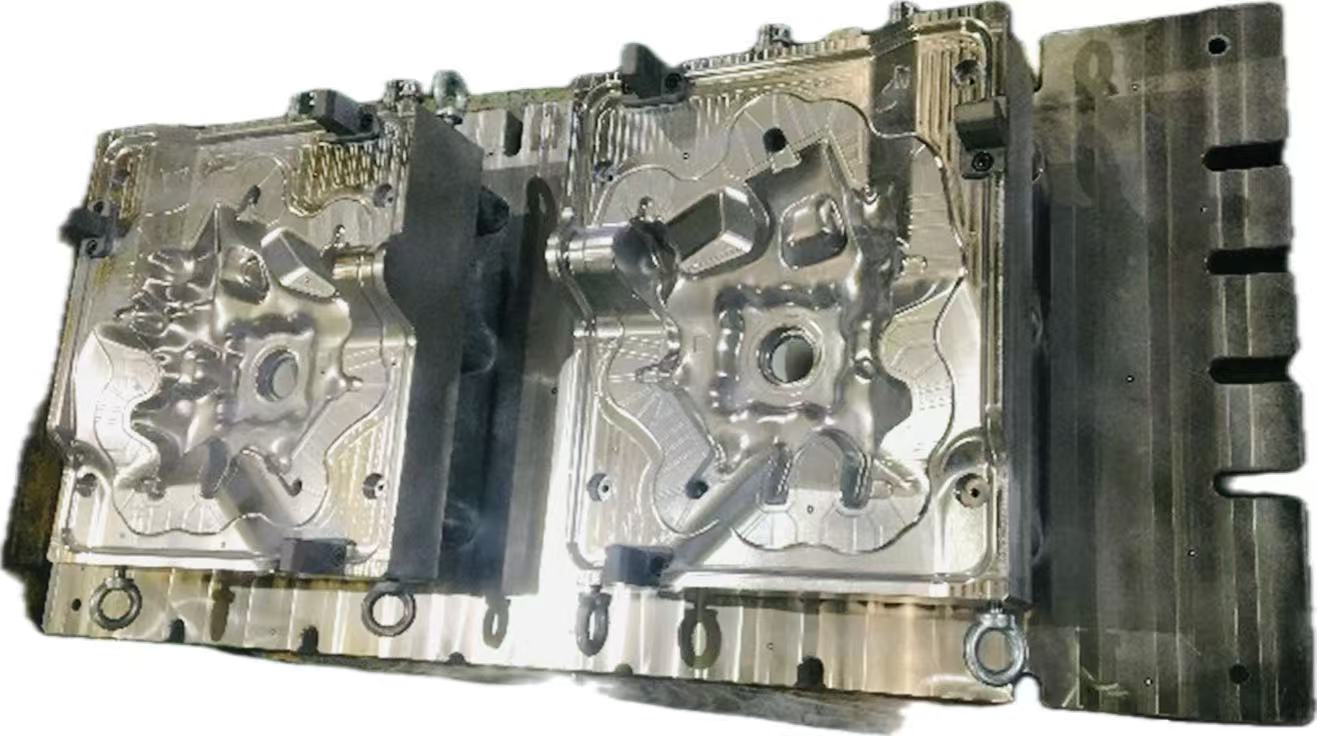
With the accelerating trends toward new energy vehicles and lightweight construction globally, the die and molding technology sector is experiencing a new wave of innovation. At the 2024 International Advanced Manufacturing Technology Summit, industry experts held in-depth discussions centered on core tooling technologies such as Die Casting Die, Gravity Die Casting Mold, Hot Stamping Die, and Low-Pressure Die Casting Mold. The collaborative innovation of these dies and molds is redefining the production efficiency and quality boundaries for critical automotive components including structural parts, chassis systems, and battery housings.
In the field of high-pressure die casting, a new generation of large-scale integrated Die Casting Die has successfully achieved single-shot forming of oversized rear floor assemblies, with locking forces exceeding 12,000 tons, thanks to optimized gating and exhaust systems combined with vacuum-assisted design. Meanwhile, the Gravity Die Casting Mold remains irreplaceable for components requiring high density, such as aluminum subframes and engine mounts, due to its excellent feeding capability and low porosity tendency. For manufacturers of high-strength vehicle body structures, significant breakthroughs have been made in the quench temperature control technology of Hot Stamping Die, consistently achieving tensile strengths exceeding 1,500 MPa in boron steel panels while maintaining springback within 0.3 mm.
Notably, the Low-Pressure Die Casting Mold has experienced explosive growth in the production of new energy battery pack enclosures and wheel hubs. By employing low, stable filling pressure, it substantially reduces turbulent gas entrapment, significantly enhancing the mechanical properties and leak-tightness of castings. At the origin of all these precision forming processes lie the Patterns for Molding Line and Core Boxes, whose precise design and high-efficiency machining are essential. Modern foundries widely adopt 3D-printed sand molds for rapid fabrication of Patterns for Molding Line, while modular Core Boxes systems improve the efficiency of producing sand cores with complex internal cavities by over 50%, reducing mold development lead times by nearly 30%.
Industry analysts point out that over the next five years, suppliers with integrated capabilities in die casting, hot stamping, and multi-process mold design will become core strategic partners for OEMs. The continuous optimization of Gravity Die Casting Mold and Low-Pressure Die Casting Mold for premium lightweight components, together with the digital upgrade of Patterns for Molding Line and Core Boxes, collectively build a full-process competitiveness ranging from blank to finished part, and from molding to core-making.
"Without high-precision Core Boxes, you cannot achieve the sand core accuracy required for complex oil passages and water jackets. Without intelligent Patterns for Molding Line, the flexible production of automated molding lines would be impossible," said the technical director of a renowned mold and die company at the conference. "We are deeply integrating simulation, additive manufacturing, and these traditional tooling processes to provide customers with one-stop lightweight solutions—from Hot Stamping Die to Die Casting Die."
It is foreseeable that with the continued iteration and cross-integration of these die and mold technologies, the automotive manufacturing industry will enter a new era of higher efficiency, greater precision, and lower carbon emissions.